We craft custom solid wood staircases in three construction types: stringer stairs (mortised and saddled) and folded stairs. We build every staircase individually from high-quality woods such as beech, oak, or ash, and finish it lacquered, oiled, or color-treated. Within 75 km of Witten we offer consultation, measurement and installation – beyond that we deliver throughout Germany and the DACH region.
Discover our diverse designs: Different construction types – each unique in its own way, from the classic stringer construction to the minimalist folded staircase.
Dive into the world of materials: Different materials, each brings its own character. Whether beech, oak or more exotic woods – each material gives your staircase a special touch.
Explore our surface options under surfaces: From lacquers that offer protection and shine, to oiled surfaces that preserve the natural feel of the wood – each variant gives your staircase an individual look.
For additional information, visit our More Details section: Learn more about special stair elements such as closed stairs, baluster spindles, handrail shapes and balustrades – important details that contribute to the overall effect and functionality of your staircase.
Or check out our directly to see real projects, different compositions and their prices.
Our custom solid wood staircases cost between EUR 3.000 and EUR 12.000 groß per storey, including on-site measurement, manufacturing, and installation. The exact price depends on construction type (mortised or saddled stringer stair, folded stair, landing stair), wood species (beech, oak, ash, exotic woods), surface finish, and optional extras such as custom railings or exotic woods.
The range reflects our typical 2026 projects. Smaller straight stairs start at the starter level; elaborate landings or folded stairs with premium woods reach the deluxe range. On-site measurement costs a flat EUR 150 to 250, including travel to and from site. Standard manufacturing time is 4–6 weeks; express delivery is available.
A solid wood staircase is a staircase whose stringers and treads are both made from solid wood — from continuous or finger-jointed lamellae laminated in grain direction. The wood itself carries the load.
In practice: with us, treads are made from continuous or finger-jointed solid wood lamellae, laminated in grain direction. No veneer surfaces, no engineered wood on a carrier board — the wood is solid throughout. The best-known alternative is the clad staircase: it also uses solid wood treads, but without its own stringers — the treads are mounted directly onto an existing concrete or metal substructure that carries the load. Engineered wood and veneer panels are not options we use in stair building — they belong to furniture and industrial work.
Why does this matter? Because solid wood works for decades, can be re-oiled or re-sanded, and with proper execution lasts a lifetime. A solid wood staircase is therefore less a fitting than a long-term part of the building — more comparable to a wooden roof or parquet floor than to a piece of furniture.
Mehr Informationen – wenn Sie es genau wissen wollen.
The right construction type for a project depends on the floor plan, ceiling height, style, and budget. The four constructions we build in our Witten workshop cover virtually all use cases — from the classic old-building stringer stair to the minimalist folded staircase in an open kitchen. We deliberately do not build bolted stairs because they require special wall constructions and are outside our workshop's core competency.
In a mortised stringer stair, treads sit in vertical grooves inside the stringers. The most traditional form of German stair construction, proven for centuries. With us the grooves are about 15 mm deep and milled to the millimetre; the stringers themselves are 40 to 45 mm thick.
Mortised stringer stairs are the right choice when robustness and a classic look are desired. They suit old buildings, apartment houses, and rural or traditional-style homes. Statically they are very load-bearing and can be used as main or secondary stairs.
Mortised stringer stairs with us start at about EUR 3,000 (simple execution in finger-jointed beech) and go up to around EUR 10,000 for demanding deluxe variants in oak with custom dimensions and decorative stringer profiles.
On a saddled stair, treads sit on top of the stringers — stringers are visible, treads overhang them laterally. With us the treads are joined to the stringers with 16 mm dowels and plate-clamp screws, so no screw heads are visible from above.
This type is popular in modern single-family homes, loft apartments, and open living areas. It feels more spacious, lets more light through, and can set a strong design accent with visible grain on the underside of treads.
Saddled stringer stairs with us start at about EUR 5,000 and go significantly higher depending on wood species, surface, and add-ons.
A folded staircase is formed from a continuous wood surface folded alternately horizontal (tread) and vertical (riser) — hence the name. In our workshop we join tread and riser with a butt joint reinforced by 16 mm dowels — not a mitred cut, but a robust shoulder joint that stays stable for decades.
Folded stairs are first choice for minimalist architecture, design homes, and renovations where the staircase becomes the visual centerpiece. We offer two main variants: the saddled folded staircase with two visible stringers and the cantilevered folded staircase, which carries its load via the railing and appears entirely stringer-less.
The saddled folded staircase (with two stringers) starts at about EUR 7,000. The cantilevered folded staircase (load via railing) starts at around EUR 12,000 and can go significantly higher depending on wood, railing, and extras.
With us landing stairs are usually straight flights interrupted by one or two large landings — a direction change is possible but not mandatory. The landing itself is a full structural part with its own frame of solid wood and a walk-on panel.
Landing stairs are the standard when ceiling height exceeds about 3 meters or 18 steps are exceeded — German DIN 18065 requires an intermediate landing beyond that number for ergonomic reasons. Also when a long flight should be ergonomically interrupted or when L-/U-shaped floor plans make a direction change necessary.
Landing stairs require more material and sit in the standard-to-premium range (EUR 6,000–10,000 and higher for multi-landing variants).
Mehr Informationen – wenn Sie es genau wissen wollen.
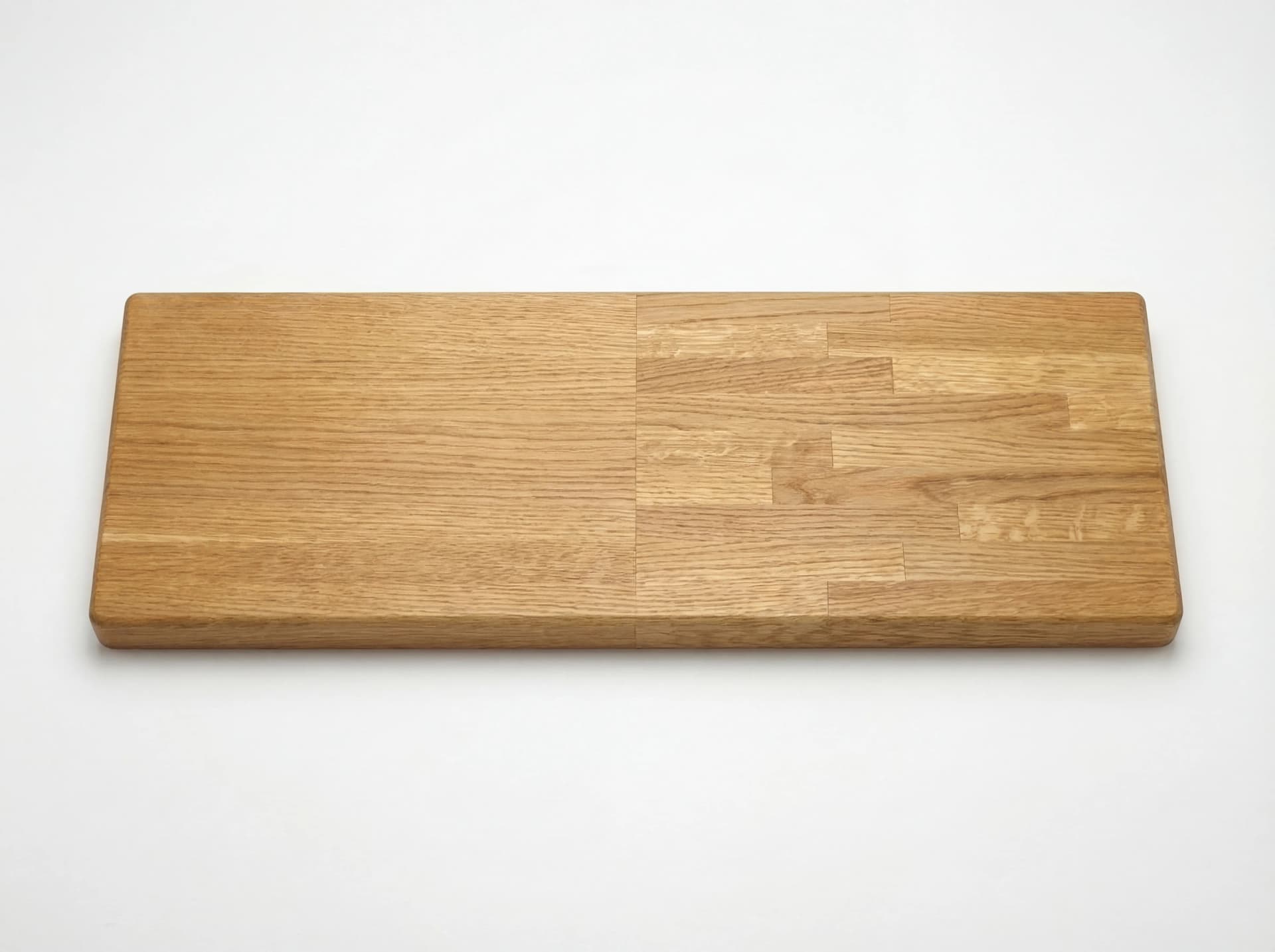
Long, continuous wood slats are used here, giving the staircase a uniform, elegant look. This construction highlights the natural grain of the wood and ensures a high-quality appearance.
In this variant, shorter pieces of wood are joined together by finger joints, resulting in a stable and economical solution. The finger-jointed elements offer a characteristic look that emphasizes the natural wood image through the connection of different wood pieces.
Wood species determines the look, hardness, care effort, and price of a staircase more than any other single decision. While oak and beech are the classics in German stair-building, ash, maple, and exotic woods offer specific advantages for particular requirements.
At HTS Panknin we work primarily with native hardwoods. They are sustainably available, have well-known mechanical properties proven over decades, and age predictably beautifully. Exotic woods are used on explicit customer request — only from FSC or PEFC certified sources.
Oak is the most requested wood in German stair-building. It is hard, durable, takes oil and lacquer well, and develops a warm patina over the years. Oak works in almost any interior style — from country cottage to modern loft.
Beech is slightly harder than oak and has an even, understated grain. It looks bright and friendly, often the first choice for modern, bright interiors. Because it shows little knot figure, it appears calmer than oak.
Ash offers more pronounced grain than beech and is somewhat lighter than oak. It is particularly elastic, predestining it for curved handrails. Ash darkens less than oak and keeps its light color longer.
Maple is the lightest native hardwood with a creamy white to light yellow color. It is medium-hard, very even in grain, and ideal for minimalist, Nordic interior styles.
Merbau, walnut, teak, or cherry are available on request. Exotic woods are often significantly more expensive but have specific visual properties (very dark tones, intense colors, special grain) that native woods cannot achieve.
Rule of thumb: for a heavily used main stair in a family home, oak is the safest choice — robust, timeless, easy care. For a brighter look, beech combined with white-lacquered risers is a classic. For distinctive aesthetics, ash or an exotic wood is ideal. Either way, we decide together during consultation — we show you samples of all woods in our showroom in Witten.
Different surfaces – each has a different effect.
Lacquered surfaces provide a protective layer that protects the wood from moisture and wear while giving it a glossy and smooth appearance. This method highlights the natural grain of the wood and ensures a durable, easy-care surface. Lacquered stairs are particularly resistant to scratches and stains, making them ideal for high-traffic areas.
Oiled surfaces preserve the natural feel and appearance of the wood while protecting it from external influences. The oil penetrates deep into the wood, emphasizes the grain and enhances the natural colors of the material. This surface gives your staircase a warm, matte look that lets the wood breathe and requires regular care to maintain the beauty of the wood long-term.
Color-treated surfaces allow you to give your staircase an individual touch by designing the wood in different colors. Whether opaque colors or colored oiling – this method offers the possibility to adapt the wood to the desired interior while the natural structure and grain remain visible. You can both color-lacquer and oil the wood, depending on the desired effect. Color-treated stairs are ideal for setting accents and creatively designing your rooms.
Mehr Informationen – wenn Sie es genau wissen wollen.
With the closed staircase, treads and risers are continuously connected – there are no openings between the steps. This construction ensures a calm, safe appearance and prevents objects from falling through or children's feet from slipping through. Additionally, the space under the stairs can be well utilized – for example as storage space, for home technology or as an enclosed utility room.
Baluster spindles form the central element of a stair railing and provide reliable fall protection. They are available in many shapes, materials and designs – whether classic wood, modern metal or a combination. This way they can be optimally adapted to the respective staircase and the desired purpose.
The shape of the handrail affects not only the appearance but also the grip feel. Whether round, oval, angular or profiled – each shape has its own advantages. This way the handrail can be perfectly adapted to use and personal preferences.
Our balustrades secure the open area around the stairwell – discreet, stable and stylish. They are mounted directly on or next to the ceiling and reliably prevent falls. Their slim design blends inconspicuously into modern living spaces and provides clear boundaries without a bulky effect.
Our child safety rails reduce the open gaps between stair treads and thus provide additional protection for small children. They make it harder for heads or bodies to slip through and can be retrofitted discreetly and easily – for more safety in your own home.
Posts form the finish and support of the stair railing. Elaborately crafted posts set special accents and give the staircase a high-quality, individual character – from simple forms to detailed designs.
With us, the path to your custom solid wood staircase consists of five clear steps: consultation, on-site measurement (flat fee EUR 150–250, incl. travel to and from site), quote, manufacturing (4–6 weeks standard; 5–7 business days express with +20% surcharge), and installation. From first contact to finished staircase typically takes six to ten weeks.
Quotes are valid for 14 days. On order, a 50 percent deposit is due; the balance is due on handover. We grant the statutory warranty of 2 years on all stairs. With proper care (re-oiling regularly, touching up lacquered surfaces as needed), a solid wood staircase is a long-term part of the house — worn spots can be sanded and re-treated at any time.
Choosing the right staircase means balancing floor plan, occupant situation, and architectural style. The following five scenarios cover most real decisions.
In new construction anything is possible. The staircase is installed before plastering and flooring; measurement takes place at the shell-construction stage. Advantage: maximum design freedom, exact fit without compromise. Recommendation: talk to us early (at latest after roof construction) so we fit into the building schedule without later shell modifications.
In old buildings the question is usually: preserve the existing stair with tread replacement/renovation, or fully rebuild? Reasons for preservation often include heritage conservation or an iconic stairwell. Reasons for rebuild often include statics, clear width, and accessibility. We advise on both paths and show example projects from the old-building segment in our showroom. Important: in heritage-protected buildings, approval from the competent heritage authority is required before any changes. This permit process must be handled by you as the owner — we provide the technical documents and drawings the authority needs for its decision.
In renovations, the whole staircase is often not the problem — just individual treads, a worn surface, or an outdated railing. For such cases we offer targeted individual measures — see also our /treppenstufen page. Important: on-site measurement is required even for smaller renovations because old buildings are rarely square. Partial renovations start at around EUR 2,400; a completely new staircase starts at around EUR 3,000 (simple mortised stringer stair in finger-jointed beech).
Balusters with maximum 12 cm spacing are a building code requirement (DIN 18065) and are included on every staircase we build — regardless of whether children use it. Two additional child-friendly features we recommend: closed risers (prevent children from slipping through) and a slip-resistant surface (preferably oiled rather than high-gloss lacquered). Planned child-safety gates for the top and bottom: we can integrate the mounting points into the design so no unclean drillings are needed later.
With age, ergonomic tread dimensions become more important. A comfortable stair has a rise of 17 to 18 cm and a going of 27 to 29 cm. If accessibility is relevant, we can plan wider treads, a second handrail on the opposite side, and contrasting risers. For households where accessibility is foreseeable, planning a stair with 100 cm clear width instead of the usual 90 cm can be worthwhile already in new construction — for added daily comfort. Stairlifts are not our field; we recommend a specialized provider whom you would commission separately.
We regularly receive the following questions in consultation. For deeper answers, visit our FAQ section — we have over 50 detailed answers bundled there.
From order to installed staircase usually takes four to six weeks. Actual workshop manufacturing is about two to three weeks; scheduling for measurement and installation adds to that. For urgent cases, express manufacturing in five to seven business days is available at a 20 percent surcharge.
For a heavily used main stair in a family home, we recommend oak. It is robust, timeless, and easy care. For a brighter look, beech or ash. We decide together during consultation — in the Witten showroom we have samples of all common woods.
In most cases, no. Replacing or renewing a staircase within existing rooms is permit-free as long as direction, ceiling height, and the load-bearing construction do not change. For structural changes (e.g. new floor opening) or in heritage-protected buildings, coordination with the building authority is required. We flag this in consultation if your project might be permit-required.
Yes. The stair load is carried by the wall stringer, which is anchored into the masonry. The free stringer rests on the finished floor and transfers part of the load there — unproblematic with underfloor heating. Prerequisite: the screed must be completely dry before installation (for new screed or underfloor heating, always wait for the heating protocol) because damp screed draws moisture into the wood and can cause joints or warping.
Installation should be done by skilled personnel. We do offer to manufacture the staircase only — installation is then carried out by you (owner's own work) or by another tradesperson. The statutory warranty covers the components but not installation quality — damage from incorrect installation is not covered. We do not offer on-site installation guidance, but we are reachable by phone for questions.
We manufacture and deliver throughout Germany as well as Austria and Switzerland. We offer on-site measurement within a radius of 75 kilometers around Witten — covering most of the Ruhr area and adjacent regions.
Outside the core measurement area, we work based on customer-taken measurements or architect plans. In those cases we guide you with detailed fill-in templates and check the dimensions before production starts. For complex projects outside the 75-kilometer radius, a paid on-site measurement trip can be arranged.
Delivery is combined with installation — the staircase arrives as a pre-finished component set and is installed on site in four to eight hours per storey. For regions outside the DACH countries please inquire individually — we assess feasibility and logistics case by case.