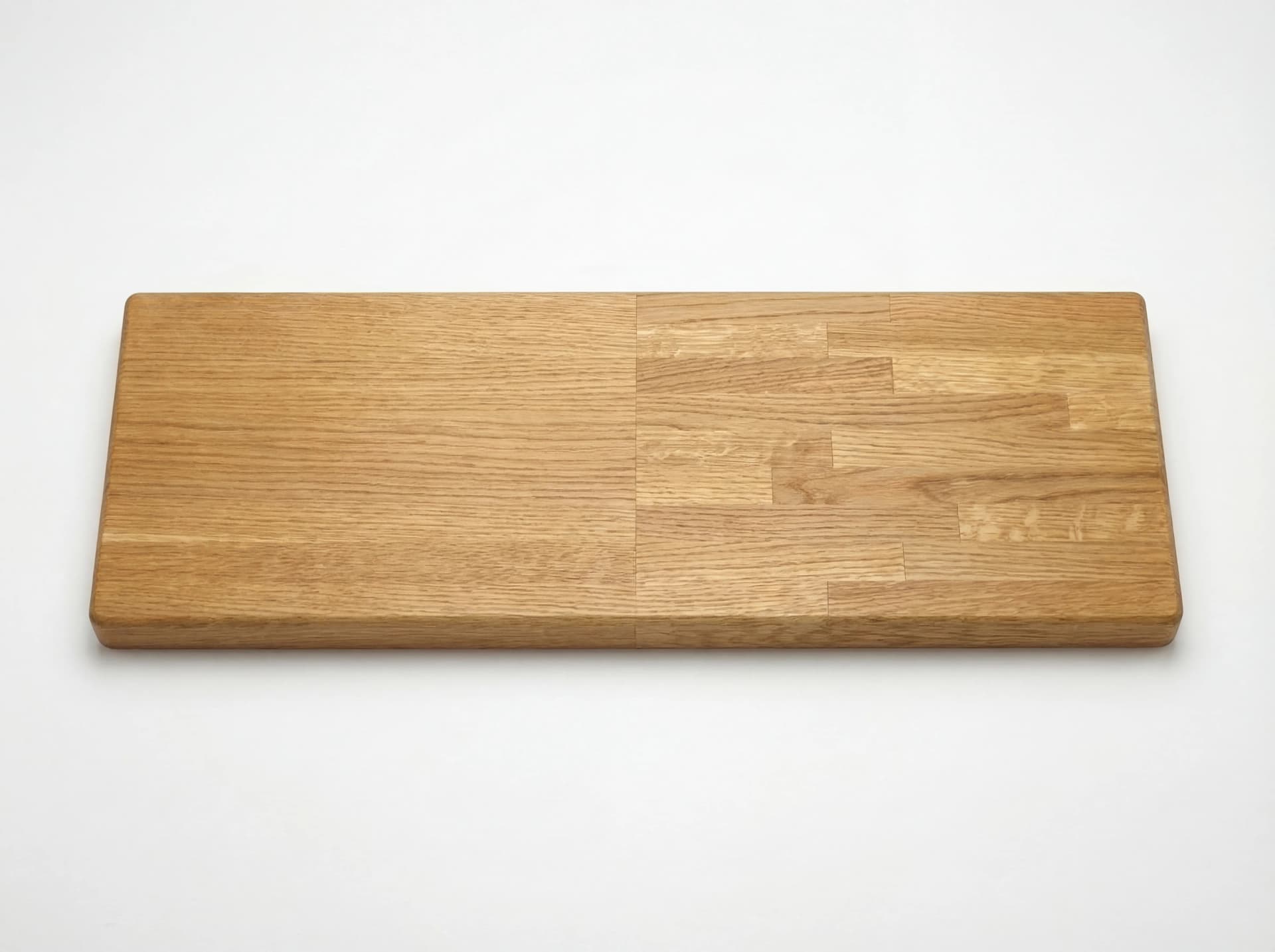
We craft custom solid wood stair treads for concrete and metal substructures. We offer the treads in various wood types (beech, oak, ash, hevea) and finishes (lacquered, oiled, color-treated). Whether professional tread replacement with digital measurement technology or a DIY project with self-installation – we offer the right solution for every need.
We install stair treads on concrete or metal substructures.
Check out our selection of materials: From solid oak to elegant ash wood to exotic woods, each material brings its own advantages and characteristics.
Choose from various surfaces: Whether oiled, lacquered or color-treated – each surface gives the treads an individual look while protecting the wood from external influences.
We measure your treads precisely on-site, without removal. After digital capture, we produce perfectly fitting treads that are then seamlessly exchanged.
Take on your stair project yourself: Measure, configure and install your treads independently. We support you with instructions, videos and an online configurator. Optionally, you can order templates to make sure everything fits before ordering the final treads.Find detailed instructions and tips here:DIY
Or check out our Exhibition directly to see real projects, different compositions and their prices.
With us, covering a concrete stair with solid wood costs between EUR 220 and EUR 300 per tread, and replacing metal-stair treads costs between EUR 200 and EUR 230 per tread. Prices include on-site measurement, manufacturing, and installation. Wood species, tread size, and the condition of the substructure determine the final price.
Both options can usually be installed in a single day without removing the existing staircase. That is significantly cheaper than a full replacement and a fast solution for aged concrete or metal staircases. Wood is selected per customer preference (oak, beech, ash, or exotic woods).
Cladding a concrete stair with solid wood or replacing the treads of a metal staircase — both transform an existing stair in just a few hours. The substructure stays completely intact; only the walking surfaces are renewed.
Whether wood cladding or tread replacement is possible depends primarily on the substructure condition. Concrete must be dry and crack-free, steel rust-free and load-bearing. If that is the case, renewing the treads is the fastest and most economical way to a visually and tactilely new staircase.
If the substructure itself has defects — cracks in concrete, rusted-through steel — the substance must be repaired first. If a metal stair has reached the end of its lifespan entirely, a complete replacement with a solid wood staircase may make sense — more on our staircase page.
Our tread renovations fall into two categories: concrete cladding and metal stair tread replacement. For both we have proven methods and realistic price ranges.
Concrete cladding covers an existing concrete stair — typical in 60s–80s duplex homes — with solid wood treads. The concrete construction stays completely intact; the wood is applied directly on top. The process is quiet, low-dust, and usually completed in one working day.
Technically the concrete surface is first cleaned and, if necessary, leveled; then prefabricated solid-wood treads are glued on. Depending on the look, risers are made from solid wood or from melamine-coated MDF. Edges are either straight or lightly rounded.
Concrete cladding with us costs EUR 220–300 per tread including measurement, manufacturing, and installation. For typical 13–16 treads this totals EUR 2,860–4,800 — well below the cost of a new staircase. Risers are usually included in this range; exotic wood surcharges are separate.
Metal stairs with worn or unattractive treads — often from the 80s/90s with PVC or grating — gain a completely new look and feel through solid wood replacement. The steel structure stays untouched; only the treads change.
Solid wood treads are fixed to the steel substructure with hidden screws or glue joints. Wood selection matters: beech or oak are standard because they transfer mechanical load well. Our clear coat finish is slip-resistant and ensures safe footing even under heavy use.
Metal-stair tread replacement with us costs EUR 200–230 per tread. Grating or PVC stairs with 13 treads cost about EUR 2,600–3,000 complete. Manufacturing lead time is 4–6 weeks; express variants are possible.
Mehr Informationen – wenn Sie es genau wissen wollen.
Treads are by far the most heavily loaded part of a staircase. Wood choice and surface treatment determine durability, slip resistance, and appearance.
On a typical household stair, each tread is walked on several thousand times per year. Harder woods like oak (34 N/mm²), beech (36 N/mm²), and ash (37 N/mm²) show virtually no wear even after decades. Maple (27 N/mm²) is adequate for secondary stairs or little-used access but is borderline for main stairs in family homes. Exotic woods like merbau (48 N/mm²) are exceptionally hard but significantly more expensive.
At HTS Panknin we offer two surface options for treads:
Standard with us: 40 mm for treads, 19 mm for risers. For folded-plate cladding, both treads and risers are made from 40 mm stock. If rise heights of the existing stair need leveling, material thickness behind the visible edge can be varied — the front edge always stays at 40 mm.
Mehr Informationen – wenn Sie es genau wissen wollen.
Long, continuous wood slats are used here, giving the staircase a uniform, elegant look. This construction highlights the natural grain of the wood and ensures a high-quality appearance.
In this variant, shorter pieces of wood are joined together by finger joints, resulting in a stable and economical solution. The finger-jointed elements offer a characteristic look that emphasizes the natural wood image through the connection of different wood pieces.
Different surfaces – each has a different effect.
Lacquered surfaces provide a protective layer that protects the wood from moisture and wear while giving it a glossy and smooth appearance. This method highlights the natural grain of the wood and ensures a durable, easy-care surface. Lacquered stairs are particularly resistant to scratches and stains, making them ideal for high-traffic areas.
Oiled surfaces preserve the natural feel and appearance of the wood while protecting it from external influences. The oil penetrates deep into the wood, emphasizes the grain and enhances the natural colors of the material. This surface gives your staircase a warm, matte look that lets the wood breathe and requires regular care to maintain the beauty of the wood long-term.
Color-treated surfaces allow you to give your staircase an individual touch by designing the wood in different colors. Whether opaque colors or colored oiling – this method offers the possibility to adapt the wood to the desired interior while the natural structure and grain remain visible. You can both color-lacquer and oil the wood, depending on the desired effect. Color-treated stairs are ideal for setting accents and creatively designing your rooms.
Before manufacturing treads, core dimensions of a stair must be captured exactly. DIN 18065 sets the framework for comfort and safety.
Key dimensions are rise (vertical distance between steps), going (horizontal tread surface), and overhang (tread projection over riser). For main stairs in residential buildings, comfortable values are 17–18 cm rise and 27–29 cm going.
DIN 18065 defines for necessary main stairs in residential buildings a minimum clear width of 80 cm (from 1 unit) or 100 cm (from 3 units), a maximum rise of 20 cm, and a minimum going of 23 cm. For tread replacement on existing stairs, geometry does not need to change — the DIN strictly applies only to new stairs. We still check dimensions and flag deviations, especially in steep old-building stairs.
Replacing stair coverings on concrete and metal stairs — millimetre-precise thanks to digital contour measurement
Does your concrete or metal staircase have a worn wooden covering? We capture each step on site contour-precisely with a digital measuring device, produce the new solid wood treads 1:1 to match in our workshop in Witten, and install them on the existing construction. You will find all the details on process, materials and prices on our service page.
More about professional stair tread replacement:To the service pageTread replacement follows five clear steps: measurement (flat fee EUR 150–250, incl. travel to and from site), workshop production, removal of old treads, installation of new treads, and finish. Total duration from inquiry to finished stair is typically four to six weeks; the on-site work itself often just one day.
Total duration from inquiry to finished stair: typically 4–6 weeks (of which 3–4 weeks manufacturing). Actual on-site work: usually one day. Thanks to 2-component foam, the stair is fully load-bearing again the same day.
Mehr Informationen – wenn Sie es genau wissen wollen.
You measure your steps yourself: with our instructions and videos we show you exactly which dimensions you need for each step – width, depth and angle. From these you configure your perfectly fitting solid wood treads conveniently online.
Not sure about the dimensions? Order cardboard templates first. Use them to check on site whether each step fits exactly – only then do you place the order for the final wooden treads. This avoids incorrect orders.
You install the finished treads yourself on your concrete or metal staircase. Our step-by-step instructions and videos guide you through screwing and gluing – the right tools and some manual skill are all you need.
We regularly get the following questions at the measurement appointment. For deeper answers see our FAQ with over 50 entries.
On-site duration depends on construction type: metal stair tread replacement takes two to four hours, concrete stair cladding with risers takes six to eight hours. Both are completed in a single day. From inquiry to installation day usually four to six weeks, because treads are custom-made.
No. Because treads are finished in the workshop, only little dust and no lacquer or oil odor arises on site. We carefully cover the surroundings and clean after installation. The stair is usually usable again the same evening.
During installation itself (2–8 hours depending on type) the stair should not be used. In duplex homes with a single stair, we plan work so that traffic between floors is possible in the morning and evening. After bonding with 2-component foam, the stair is fully load-bearing again after about 20 minutes.
Yes, as long as the substructure is load-bearing and free of structural defects. On an old concrete stair we check whether the concrete is still tensile-strong. On steel we check for rust-free condition. Cladding or tread replacement is possible in most cases; in individual cases we advise against it if the substance is no longer sufficient.
As a rule, no. Cladding a concrete stair or replacing treads on a metal stair changes neither the load-bearing structure nor the geometry and is therefore permit-free. If in doubt, we are happy to clarify at the measurement appointment.
We offer tread replacement with on-site measurement within a radius of 75 kilometers around Witten — covering most of the Ruhr area, Sauerland, and adjacent regions. Delivery throughout Germany plus Austria and Switzerland.
Outside the core measurement area, treads can be manufactured based on customer measurements. If you provide us with measurement templates or CAD files, we manufacture the treads and ship them by freight — or you can pick them up directly at our workshop in Witten.